






Buying solar panels often sounds like a win-win: clean energy, lower monthly utility bills, and a higher property value. But when high-pressure sales tactics meet long-term financing, thousands of homeowners end up in a financial bind.
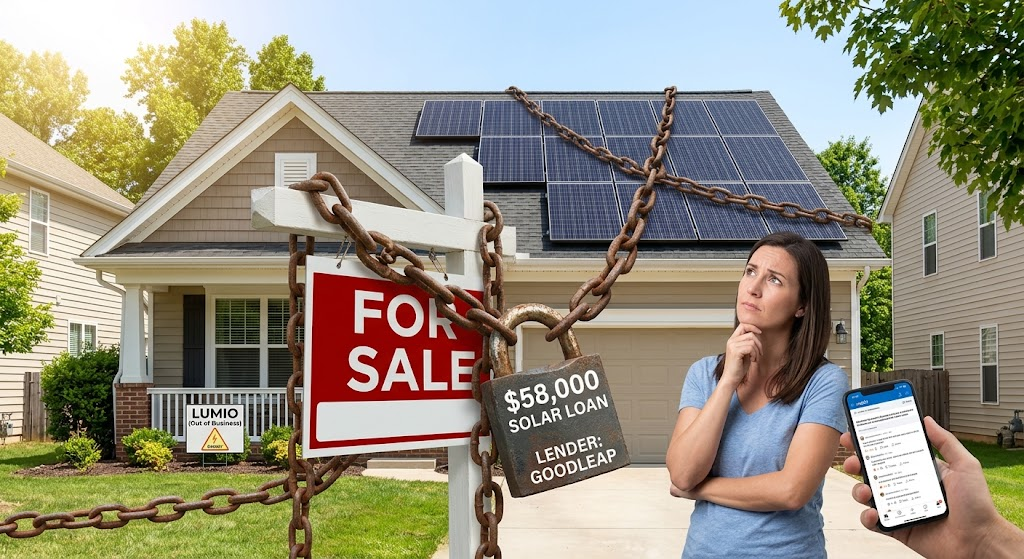
A common scenario playing out across the real estate market involves homeowners who financed a massive solar array—often paying upwards of $60,000—only to find themselves needing to sell their home just a few years later with $50,000 or more remaining on the loan. Worse still, if the original installer went bankrupt (as was the case with companies like Lumio), homeowners are left managing orphaned systems serviced by third-party lenders like GoodLeap.
If you are trying to sell a home burdened by a massive solar loan, here is what you need to know about your options, the tax implications, and how to navigate closing without wrecking the deal.
The Three Ways to Handle a Solar Loan When Selling
When you have a solar loan attached to your property, the lender typically places a Uniform Commercial Code (UCC) financing statement—often called a fixture filing—against the panels. This filing isn’t a mortgage lien on your entire house, but it prevents you from transferring a clear title to a new buyer until the debt is resolved or formally reassigned.
You generally have three paths forward.
1. Pay Off the Loan at Closing Through Escrow (The Cleanest Route)
This is the approach recommended by experienced real estate professionals and title companies. You do not need $58,000 in cash sitting in your bank account today to get rid of the loan.
Instead, you handle the solar debt just like your primary mortgage:
- Your title company contacts the lender (e.g., GoodLeap) to get an official payoff statement.
- When the buyer funds the purchase of the home, the escrow officer uses the proceeds from the sale to pay off the solar balance directly.
- The solar lender releases the UCC filing, clearing the title for the new owner.
For this option to work, your home must have enough equity to cover real estate commissions, closing costs, your primary mortgage payoff, and the remaining solar balance.
2. Transfer the Loan to the Buyer (The Hard Sell)
Most specialty solar loans are contractually transferable, meaning a buyer can apply to assume the remaining monthly payments. However, convincing a homebuyer to assume tens of thousands of dollars in debt for an existing system is difficult.
- When it fails: If the system was significantly overpriced at installation, a buyer will likely refuse to assume the debt unless you lower the home’s purchase price dollar-for-dollar.
- When it works: If the loan holds an ultra-low fixed interest rate (such as 0.99% or 1.99% locked in around 2021–2022), it may actually serve as an asset in a high-interest-rate environment. In states with full net metering, a buyer taking over a $150/month payment at 1.99% might still save money compared to paying local power grid rates.
3. Offer a Seller Credit or Price Concession
If a buyer is open to assuming the loan but hesitant about the total price tag, you can negotiate a middle ground. You might offer a seller credit at closing (e.g., $15,000 to $20,000) to offset a portion of the assumed loan balance, acknowledging that while the panels add some value, they don’t justify the entire remaining debt.
Fact Check: How the Federal Solar Tax Credit Actually Works
A massive point of confusion for solar loan borrowers involves the 30% Federal Investment Tax Credit (ITC). Many homeowners are told by sales reps that they will “get $18,000 back from the government,” only to be surprised at tax time.
       [ Total System Price: $60,000 ]
                     │
      30% Federal Tax Credit = $18,000
                     │
 ┌───────────────────┴───────────────────┐
 │                                       │
 IF Annual Tax Liability ≥ $18k         IF Annual Tax Liability < $18k
 │                                       │
 ▼                                       ▼
 Receive full $18,000 credit            Credit reduces tax to $0;
 against tax liability in Year 1         Unused portion rolls over
 (Refunds excess tax withheld)           to future tax years (Form 5695)
Here is how the credit actually operates under Section 25D of the Internal Revenue Code:
- It is Non-Refundable: The solar ITC can only reduce your total federal income tax liability to zero. It will not pay out cash beyond what you actually owe in taxes for the year.
- Withholdings vs. Liability: “Non-refundable” does not mean you won’t get a tax refund check. If your employer withheld $10,000 in federal taxes from your paychecks throughout the year, and your calculated tax liability is $10,000, a $10,000 solar credit reduces your liability to $0. The IRS will then refund the entire $10,000 that was withheld from your paychecks.
- Carryover Rules: If your tax credit is larger than your total tax liability for the installation year, you do not lose the remaining balance. You can roll the leftover credit forward to future tax years using IRS Form 5695 for as long as the tax credit remains active under federal law.
Note: Consult a certified CPA or tax professional to evaluate your specific Form 1040 liability.
Do Solar Panels Increase Home Value Enough to Cover the Debt?
Industry studies from the National Renewable Energy Laboratory (NREL) and Zillow research show that homes with owned solar panel systems sell for an average of 3.5% to 4.1% more than comparable homes without solar. On a $500,000 home, that represents an added value of roughly $17,500 to $20,000.
However, there is a critical distinction that appraisers make:
| System Status | Impact on Sale & Home Value |
| Fully Owned (Paid Off) | Positive asset. Adds tangible property value, lowers buyer utility costs, and simplifies the transaction. |
| Financed (High Balance) | Encumbrance. If the debt ($58,000) exceeds the added market value (~$20,000), the net position is negative, creating friction in escrow. |
Action Plan for Sellers with Solar Loans
If you are getting ready to list a property encumbered by solar debt, follow these steps to avoid closing delays:
- Request an Official Payoff Statement: Contact your loan servicer (such as GoodLeap, Mosaic, or Sunlight Financial) and request a formal payoff letter along with details on their UCC release process.
- Review Your Original Purchase Agreement: Check if the contract includes performance guarantees or production warranties. If the system was grossly underperforming due to faulty installation, you may have legal grounds to dispute portions of the balance with the assignee.
- Hire a Solar-Educated Real Estate Agent: Avoid agents who view solar as an insurmountable obstacle. Work with a Realtor who understands how to calculate system production, read utility bills, and present low-interest financing as a utility-saving feature to prospective buyers.
- Determine Net Equity: Calculate your expected sale price minus your mortgage, real estate agent fees, and the solar payoff. If your net equity is positive, paying off the loan through title at closing remains your smoothest, most reliable option.