






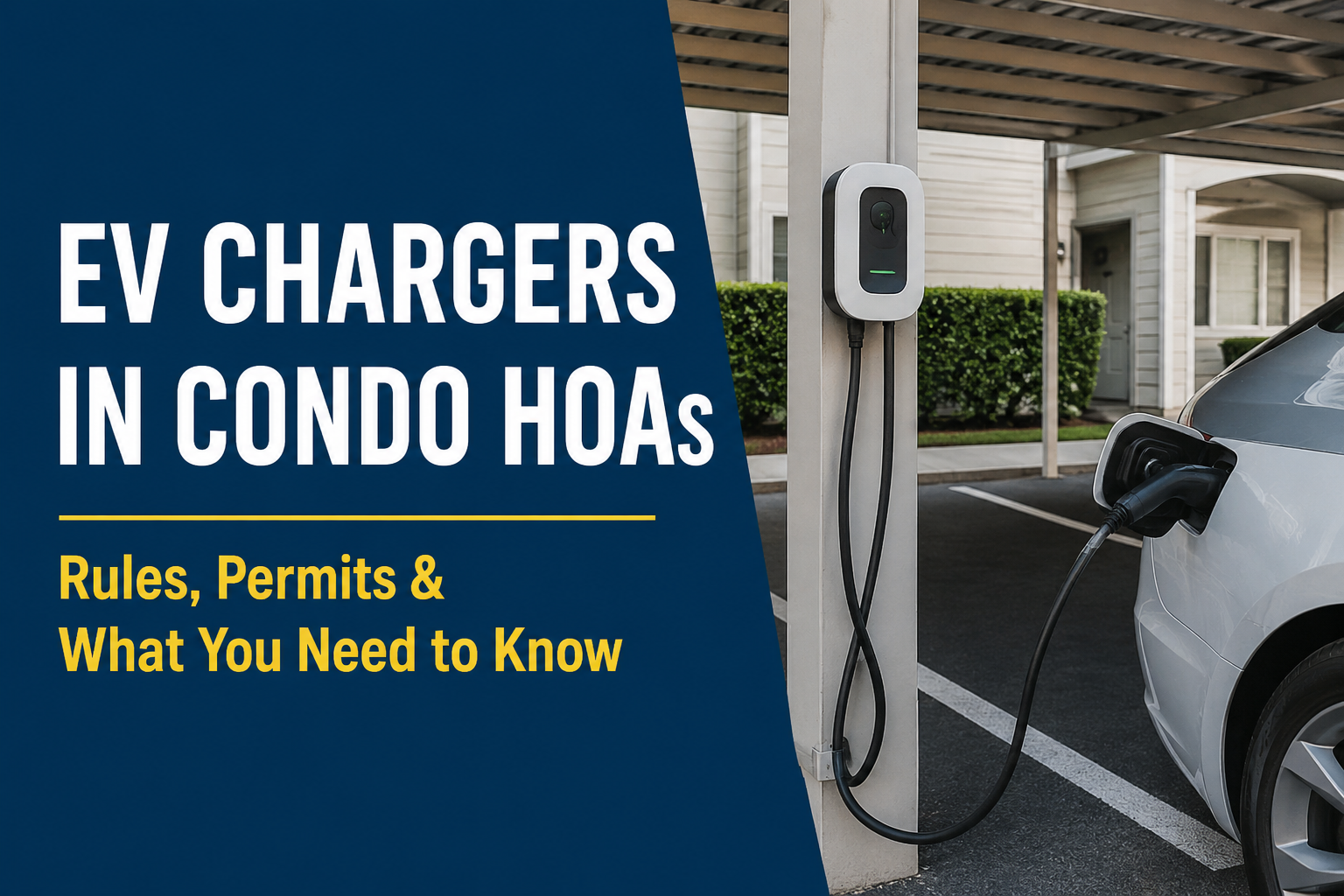
Electric vehicles are becoming more common, and many condominium and homeowners associations are now facing a question that did not exist when their governing documents were written:
Who is allowed to install an EV charger, and what rules should apply?
The question can become complicated when parking spaces, carports, electrical systems, and other areas are shared or classified as common elements. An association may want to support EV ownership while also protecting residents from electrical hazards, unexpected repair costs, insurance problems, and disputes between homeowners.
A clear EV charging policy can help an HOA handle these issues before they become a larger problem.
Why EV charging creates challenges for HOAs
A typical condominium community may have several different types of parking arrangements. Some residents may have a private garage, while others use an assigned carport or parking space located near common property.
The electrical setup can also vary significantly.
For example, some homeowners may already have outdoor electrical outlets connected to their own electrical panels. Others may want to install a dedicated circuit for a faster Level 2 charger. In some communities, the HOA may control the electrical service for shared parking areas.
This creates several questions:
- Who pays for the electrical work?
- Who pays for the electricity used?
- Who is responsible for permits?
- What happens if the charger causes damage?
- Can a charger be attached to a common element?
- What happens when the homeowner sells the property?
These questions are why many associations choose to create written rules instead of handling each request differently.
Should extension cords be allowed for EV charging?
One of the simplest rules an association can consider is prohibiting temporary extension cords for routine EV charging.
An extension cord running from inside a home to a vehicle can create several practical problems. Cords may cross walkways, become damaged, create a tripping hazard, or be used in ways that were never intended by the manufacturer or electrical system.
The exact requirements can depend on the property, local codes, and the equipment involved. For that reason, an HOA should avoid relying only on informal rules and should obtain appropriate advice from a qualified electrician or other professional.
A written policy might generally require that charging equipment be connected through an approved electrical installation rather than through an improvised extension-cord arrangement.
Should residents be allowed to install 120-volt outlets?
Not every EV owner needs the same charging speed.
A standard 120-volt connection may be sufficient for some drivers who travel relatively short distances and can leave their vehicle charging for long periods. Other owners may prefer a 240-volt Level 2 setup because it can provide faster charging.
Instead of requiring every homeowner to install the same type of outlet, an association may want to focus on the safety and installation requirements.
Possible requirements could include:
- Installation by a properly qualified electrical professional
- Required permits where applicable
- Compliance with applicable electrical and building requirements
- Approval before work begins in common areas
- No unauthorized use of HOA-owned electrical outlets
- No installation that creates a hazard in walkways or shared areas
The exact electrical specifications should be reviewed for the particular property rather than copied from another community.
Who should pay for the electricity?
Electricity billing is one of the most important issues for an HOA.
If a homeowner’s charger is connected directly to the homeowner’s own electrical service, the billing arrangement may be relatively straightforward. The homeowner pays for the electricity used by the vehicle.
The situation becomes more complicated when a charger is connected to an HOA-controlled electrical system. In that case, the association should consider how to prevent residents who do not use EVs from unintentionally paying for another homeowner’s charging.
Possible approaches include:
Individual electrical connections
A homeowner may pay for an approved electrical connection associated with their own electrical service, where the property layout and electrical capacity make that practical.
User-metered charging
The association may install charging equipment that identifies users and records charging sessions. Users can then pay for their own consumption under the system’s billing arrangement.
A shared charging area
Instead of allowing individual chargers at every assigned parking space, an association may create a limited number of shared charging spaces.
This approach can reduce the number of individual installations but requires decisions about access, parking time limits, payment, maintenance, and availability.
What happens when a homeowner sells?
This is an issue that should be addressed before a private EV charger is installed.
A charger may be attached to a wall, storage structure, carport, or another area that is not entirely owned by the homeowner. If the homeowner later moves, several questions can arise:
- Does the charger remain?
- Can the owner remove it?
- Who repairs the conduit or wiring?
- Does the buyer accept responsibility?
- Does the association have to pay for removal?
A written approval agreement can address these questions in advance.
For example, approval could specify whether the equipment must be removed when the property is sold or whether a future buyer may accept responsibility for the installation. The agreement can also address damage caused by removal and the condition in which the property must be left.
The important point is to avoid leaving these issues unresolved until a sale occurs.
Should the HOA inspect or maintain private charging equipment?
An association should clearly distinguish between approving an installation and becoming responsible for maintaining the equipment.
A private charger may be owned and maintained by the individual homeowner. If so, the approval documents should clearly explain who is responsible for:
- Repairs
- Replacement
- Damage
- Electrical maintenance
- Insurance
- Removal
- Damage to common property
The association should not accidentally create confusion about whether it owns or maintains privately installed charging equipment.
Because liability and insurance questions can be complicated, an HOA should consider obtaining professional advice before adopting a final policy.
A simple framework for an HOA EV charging policy
A practical policy could address the following areas:
1. No unapproved installations
Residents should obtain written approval before installing permanent charging equipment or modifying electrical systems in areas controlled by the association.
2. No unsafe temporary arrangements
The association can establish rules against arrangements that create hazards, such as cords crossing shared walkways or unauthorized connections to common electrical outlets.
3. Professional installation
Required electrical work should be completed by an appropriately qualified professional and follow applicable requirements.
4. Permits and documentation
Where permits or inspections are required, the homeowner should be responsible for obtaining them and providing documentation when appropriate.
5. Electrical capacity
The proposed installation should not overload the home’s electrical system or the community’s infrastructure.
6. Responsibility for costs
The policy should clearly identify who pays for installation, electricity, repairs, maintenance, and removal.
7. Insurance and liability
The association should review its insurance requirements and determine whether additional documentation or coverage is appropriate.
8. Property transfers
The policy should explain what happens to the charger, wiring, conduit, and related equipment when the property is sold.
Should an HOA install shared chargers instead?
For some communities, a shared charging system may be easier than approving dozens of individual installations.
A shared system can allow the association to control the location, electrical infrastructure, maintenance, and billing process. Depending on the community, the association may also explore outside charging providers or utility programs.
However, shared charging also creates its own questions:
- How many spaces are needed?
- Who gets priority?
- How long can a vehicle remain plugged in?
- Who pays for installation?
- Who pays for electricity?
- Who maintains the equipment?
The right choice depends heavily on the property’s electrical layout, parking arrangement, and resident demand.
Final thoughts
There is no single EV charging policy that works perfectly for every HOA or condominium community.
The best approach is usually to create a clear process that balances three goals:
- Allow reasonable access to EV charging
- Protect the community from avoidable safety and liability problems
- Make sure the costs are paid by the people who create them
An HOA may want to avoid both extremes: completely banning EV charging or allowing residents to install equipment without approval.
A well-designed policy can provide a predictable path for homeowners who want to charge at home while giving the association a way to manage electrical work, shared property, expenses, maintenance, and future property transfers.
Before adopting a final policy, an association should consider consulting the appropriate local professionals, including a qualified electrician and legal or insurance advisers familiar with the property’s location and governing documents.
Disclaimer: This article is for general informational purposes only and is not legal, electrical, insurance, or building-code advice. Requirements can vary by location and property type. Always verify applicable rules and obtain professional advice for a specific situation.