







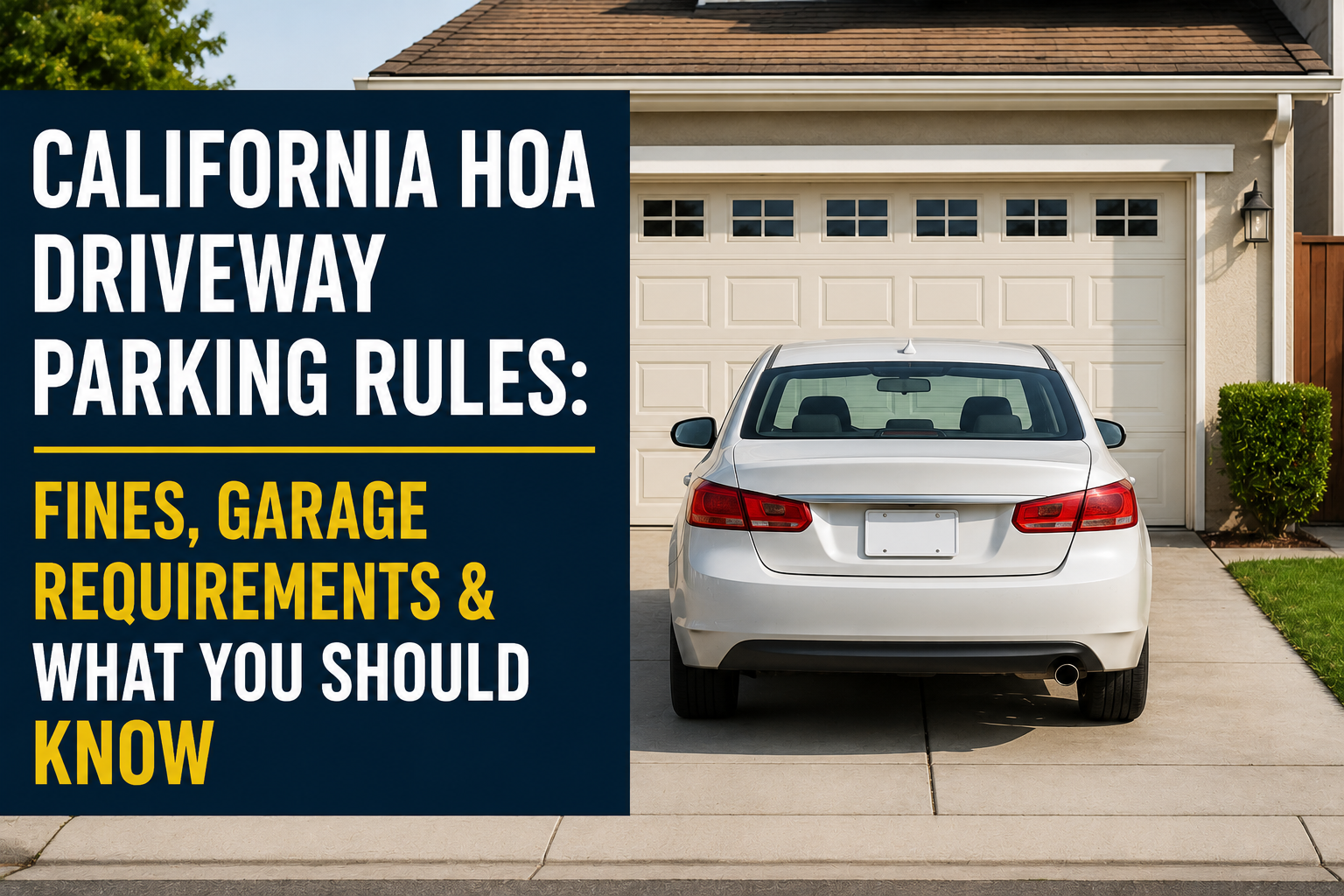
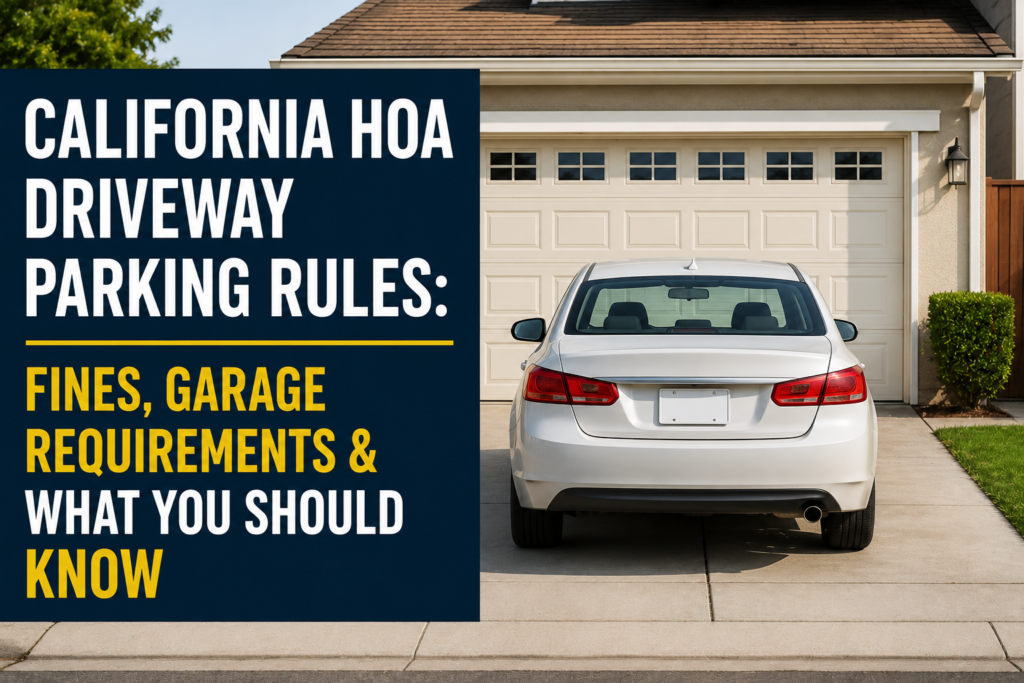
Parking rules can become a major source of frustration in a homeowners association, especially when residents have followed one practice for years and the HOA later decides to enforce the written rules more strictly.
A common example involves communities where homeowners are expected to park vehicles inside their garages before using the driveway. This can create very different situations for different homes. Some properties may have no driveway at all, while others have enough driveway space for multiple vehicles.
When an HOA begins enforcing an old parking rule, homeowners often have questions about fines, safety claims, garage inspections, and whether years of inconsistent enforcement affect the rule.
Can an HOA enforce a garage and driveway parking rule?
The first place to look is the association’s governing documents.
CC&Rs and other recorded restrictions may contain requirements about how garages, driveways, and assigned parking areas may be used. If a rule requires homeowners to keep garage spaces available for vehicle parking before using a driveway, the exact wording matters.
However, enforcement is not always as simple as reading one sentence in the CC&Rs.
The association may also need to follow the applicable notice, hearing, and enforcement procedures before imposing a fine. Homeowners should carefully review the actual rule, the violation notice, and the HOA’s enforcement process.
A board should generally avoid creating a completely different rule through informal enforcement. At the same time, a long period of inconsistent enforcement does not automatically mean that a written restriction can never be enforced again.
What if the HOA has not enforced the rule for years?
This is one of the most important questions in a long-running HOA dispute.
A rule may exist in the governing documents even if enforcement has been inconsistent. A homeowner may argue that years of non-enforcement created an expectation that the rule would not be applied strictly.
The outcome can depend on the specific facts, including:
- The exact wording of the CC&Rs
- How long the rule was not enforced
- Whether the rule was ignored for everyone or only certain homeowners
- Whether the association formally announced a return to enforcement
- Whether the current enforcement is being applied consistently
Homeowners should not assume that a rule has permanently disappeared simply because the HOA did not enforce it for a long time.
If the association wants to resume enforcement, the process and notice provided to homeowners may be important.
Is parking in a driveway automatically a safety violation?
Not necessarily.
A parking restriction may be based on many different reasons, including community design, access requirements, appearance, parking availability, or safety.
The fact that an HOA describes a rule as a safety rule does not automatically resolve the legal question. The specific circumstances and applicable law may matter.
For example, an association may have legitimate concerns if vehicles block:
- Fire lanes
- Emergency access
- Sidewalks
- Driveways
- Required access routes
That is different from a situation where a vehicle is parked in a private driveway without blocking access.
The association should be able to explain the basis for its enforcement and apply the rule according to the governing documents and applicable law.
Can an HOA inspect a homeowner’s garage?
A garage may be subject to different ownership and access rights depending on the community’s governing documents.
An HOA should not automatically assume that it can enter or inspect every private garage whenever it wants.
If an association claims that a garage is being used in a way that creates a safety or fire concern, the authority to inspect may depend on the governing documents, applicable law, emergency circumstances, and the specific facts.
Homeowners should carefully review any inspection request and determine:
- Why the inspection is being requested
- What authority the HOA is relying on
- Whether notice is required
- Who will conduct the inspection
- What areas will be inspected
- What happens if access is refused
If the issue involves an actual fire or building-code concern, the appropriate government authority may also have a role. An HOA’s own enforcement powers and a public agency’s inspection powers are not necessarily the same.
What happens if the HOA imposes a fine?
California HOA fines are subject to legal requirements and association procedures.
A homeowner should not assume that paying a fine automatically ends every possible future dispute, and should also not assume that a fine can be imposed repeatedly without following the required process.
The details can depend on:
- The type of violation
- Whether the violation is continuing
- Whether the homeowner corrected the violation
- The HOA’s enforcement policy
- The notice and hearing procedures used
- The current law that applies at the time
Because California HOA laws can change, homeowners should verify the current rules rather than relying on older online discussions or informal interpretations.
Can the HOA fine a homeowner every day?
This is an area where homeowners should be especially careful.
A continuing parking situation may be treated differently from repeated separate violations. For example, leaving a vehicle parked in a prohibited location may not necessarily be treated the same way as repeatedly moving and re-parking the vehicle.
The answer depends on the applicable law, the association’s governing documents, and the enforcement process.
A homeowner who receives a violation notice should examine whether the HOA has identified:
- One continuing violation
- Multiple separate violations
- A specific date and time for each alleged violation
- A deadline to correct the problem
- The fine amount and authority for imposing it
The association should be able to explain the basis for the enforcement action.
What should homeowners do after receiving a parking violation?
A calm, documented approach is usually more useful than immediately ignoring the notice.
1. Read the exact rule
Find the specific CC&R, rule, or policy the HOA says was violated.
Do not rely only on a board member’s summary of the rule.
2. Review the enforcement policy
Check the association’s published enforcement procedures. Look for requirements relating to notice, correction periods, hearings, and fines.
3. Ask for clarification
If the HOA says the issue is related to safety, ask for the specific safety concern and the rule or authority supporting the enforcement.
4. Document the property
Keep photographs and records showing the parking arrangement, driveway, garage, and whether any access route is blocked.
5. Avoid making assumptions about the fine
A fine may have limits, but the exact effect of those limits depends on the current law and the specific violation.
6. Consider professional advice
If the dispute involves significant money, property rights, repeated enforcement, or possible legal action, a California HOA attorney may be able to provide advice based on the actual governing documents and facts.
Can homeowners challenge an old rule?
Possibly, depending on the circumstances.
A homeowner may raise questions about inconsistent enforcement, selective enforcement, waiver, or other legal arguments. These issues are highly fact-specific.
For example, the situation may be different if:
- The HOA ignored the rule for nearly every homeowner
- The HOA enforced the rule only against one person
- The board previously represented that the rule would not be enforced
- The association recently changed its interpretation of the rule
However, a homeowner should not assume that inconsistent enforcement automatically invalidates the restriction.
The best way to evaluate the issue is to compare the written rule with the association’s actual historical enforcement and current procedures.
Could the community change the parking rule?
Sometimes the most practical solution is to change an outdated rule.
If the original restriction no longer reflects how homeowners use their properties, residents may consider whether the governing documents can be amended.
This can be difficult because amendments often require a specific percentage of homeowner approval.
A community may also need to consider why the rule was created in the first place. If the real concern is emergency access or street congestion, a more targeted rule may solve the actual problem without restricting every homeowner’s driveway use.
For example, a community might focus on:
- Keeping fire lanes clear
- Preventing vehicles from blocking sidewalks
- Keeping driveways and entrances accessible
- Restricting long-term storage of non-operational vehicles
- Addressing street parking separately
A rule that targets the actual problem may be easier for residents to understand and enforce.
Final thoughts
Parking disputes can become complicated when an HOA begins enforcing an old rule after years of inconsistent enforcement.
The key questions are usually:
- What exactly do the CC&Rs say?
- Has the HOA followed the required enforcement process?
- Is the rule being applied consistently?
- What is the actual reason for enforcement?
- Does current California law affect the fine or enforcement process?
- Does the HOA have authority to inspect the garage?
Homeowners should be cautious about assuming that a fine is automatically a one-time cost or that a long period of non-enforcement permanently eliminates a rule.
At the same time, an HOA should clearly explain its authority, follow the required procedures, and apply its rules fairly.
When a parking dispute becomes serious, the governing documents and current California law should be reviewed together. Online discussions can help homeowners identify questions to ask, but they should not replace advice based on the specific property and association documents.
Disclaimer: This article is for general informational purposes only and is not legal advice. California HOA laws and enforcement requirements can change. Homeowners should verify the current law and consult a qualified California attorney for advice about a specific dispute.