








Homeowners’ Associations (HOAs) play an important role in maintaining neighborhoods, enforcing community rules, and managing shared property. In most communities, the relationship between homeowners and the HOA is cooperative. However, disagreements can arise, especially when there is confusion over who is responsible for repairing or maintaining certain parts of a property.
One of the most common questions homeowners ask is:
“What type of lawyer do I need if I’m having a dispute with my HOA?”
The answer isn’t always straightforward. Before hiring an attorney, it’s important to understand the nature of your disagreement, review your governing documents, and explore less expensive ways to resolve the issue.
In this guide, you’ll learn which legal professionals handle HOA disputes, when it’s worth hiring an attorney, and what steps you should take before considering legal action.
Why HOA Disputes Happen
Disagreements between homeowners and HOAs usually don’t begin with lawsuits. Most start with differing interpretations of the community’s governing documents.
Common reasons include:
- Property maintenance responsibilities
- Exterior repair disputes
- Landscaping obligations
- Fence or retaining wall ownership
- Roof repairs
- Drainage problems
- Architectural approval disagreements
- Fines and violations
- Access to HOA records
- Assessment or fee disputes
Many of these issues arise because both parties genuinely believe the governing documents support their position.
Instead of assuming either side is automatically correct, it’s important to examine the documents carefully.
What Type of Lawyer Handles HOA Disputes?
If your disagreement cannot be resolved through normal communication, you’ll typically need an attorney experienced in one or more of these areas:
HOA Attorney
An HOA attorney specializes in laws governing homeowners’ associations, condominium associations, and community associations.
They regularly deal with:
- HOA bylaws
- Covenants, Conditions & Restrictions (CC&Rs)
- Declarations
- Community rules
- Board authority
- Owner rights
- Maintenance obligations
Because HOA law combines elements of property law and contract law, choosing an attorney familiar with community associations is usually the safest option.
Real Estate Attorney
Many HOA disputes also fall under real estate law.
A real estate attorney can help with:
- Property ownership questions
- Easement disputes
- Shared structures
- Boundary disagreements
- Maintenance responsibilities
- Property damage
If your issue involves structures attached to your home, landscaping features, or questions about ownership, a real estate lawyer may be appropriate.
Civil Litigation Attorney
If negotiations fail and the matter proceeds to court, a civil litigation attorney may represent you.
These lawyers focus on:
- Lawsuits
- Court hearings
- Settlement negotiations
- Trial preparation
- Appeals
Many HOA attorneys also handle litigation, making it unnecessary to hire two separate lawyers.
Start With Your Governing Documents
One of the biggest mistakes homeowners make is hiring an attorney before carefully reviewing their HOA documents.
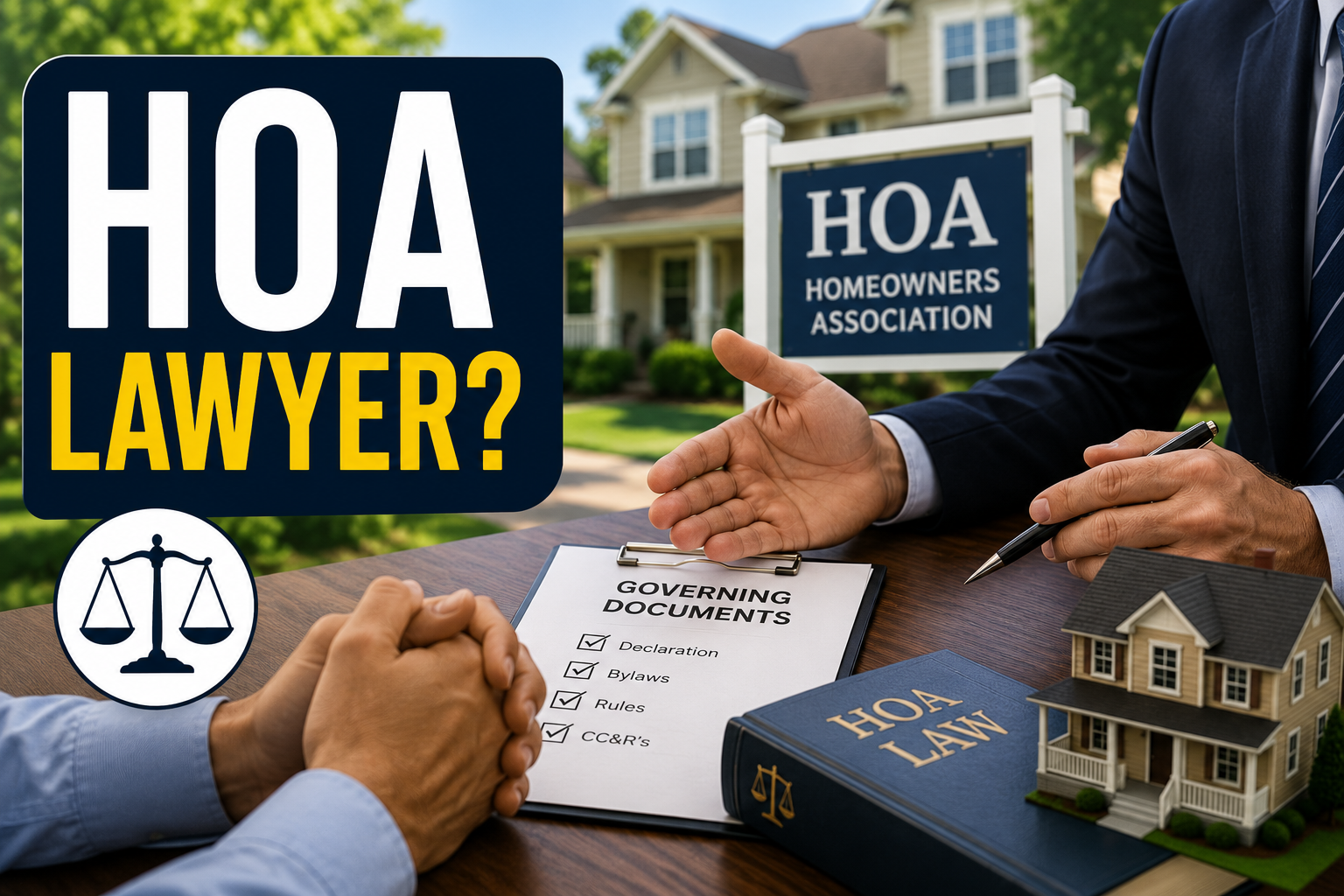
Most communities have several governing documents, including:
Declaration (CC&Rs)
This document usually explains:
- Ownership responsibilities
- Maintenance obligations
- Easements
- Common areas
- Exclusive-use areas
For many disputes, this is the most important document.
Bylaws
The bylaws explain how the HOA operates.
They generally cover:
- Board elections
- Voting procedures
- Meetings
- Financial management
- Officer responsibilities
While bylaws are important, they don’t always answer maintenance disputes.
Rules and Regulations
These address daily community living.
Examples include:
- Parking
- Pets
- Landscaping
- Noise
- Exterior appearance
Rules cannot usually override the declaration.
Understand the Difference Between Common Areas and Private Property
Many HOA disagreements involve confusion about ownership.
Generally speaking:
Private Property
Usually includes:
- Interior of the home
- Personal improvements
- Fixtures
- Flooring
- Appliances
Common Areas
Typically include:
- Roads
- Sidewalks
- Clubhouses
- Pools
- Shared landscaping
- Community lighting
However, some features fall into a gray area.
Examples include:
- Retaining walls
- Privacy fences
- Drainage systems
- Patio walls
- Exterior structures
Whether these belong to the homeowner or the HOA depends entirely on the governing documents—not assumptions.
Don’t Rely on Verbal Opinions Alone
Homeowners often receive conflicting advice.
One contractor may say the HOA is responsible.
A neighbor may disagree.
Even board members sometimes interpret documents differently.
Instead of relying solely on opinions, ask the HOA to provide the exact section of the governing documents supporting its position.
A helpful response might be:
“Could you please identify the specific section of the Declaration or CC&Rs that states I am responsible for this repair?”
Written clarification reduces misunderstandings and creates a useful record.
Ask Questions Before Hiring a Lawyer
Legal advice can be expensive.
Before scheduling consultations, consider asking yourself:
- Have I read the governing documents?
- Has the HOA explained its position?
- Have I requested clarification in writing?
- Is the disagreement based on interpretation?
- Have I spoken with board members?
Many disputes are resolved long before attorneys become involved.
Speak With the HOA Board
Remember that the management company and the HOA board are not always the same.
The board generally makes policy decisions.
Management companies usually carry out those decisions.
If your disagreement is with management, respectfully request that the board review the issue.
Board members may not even know that homeowners are experiencing recurring problems.
Present:
- Copies of correspondence
- Relevant document sections
- Photos if applicable
- Repair estimates
- A clear timeline
Professional communication often leads to faster resolutions than emotional confrontations.
Consider an Independent Legal Opinion
If both you and the HOA genuinely believe the governing documents support your position, obtaining an independent legal interpretation can be valuable.
An experienced HOA or real estate attorney may identify wording that neither side noticed.
Sometimes a single legal opinion is enough to resolve the disagreement without filing a lawsuit.
Although consultations involve a cost, they are usually much less expensive than full litigation.
Lawsuits Should Usually Be the Last Option
Many homeowners immediately think about suing the HOA.
In reality, lawsuits are expensive, time-consuming, and uncertain.
Remember:
The HOA is funded by homeowners.
If litigation occurs, the association will usually hire its own attorney.
Legal expenses may ultimately be paid using HOA funds, which come from assessments paid by community members—including you.
Depending on your governing documents and state law, the losing party may also be responsible for paying certain legal costs.
For this reason, experienced attorneys often recommend exhausting other options first.
Explore Alternative Solutions
Before going to court, consider whether one of these approaches could resolve the issue:
- Mediation
- Informal meetings
- Board review
- Written clarification
- Independent engineering reports
- Structural inspections
- Legal interpretation of governing documents
These methods often preserve neighbor relationships while reducing costs.
Does Every HOA Dispute Require a Lawyer?
Not necessarily.
Some disagreements are simply misunderstandings caused by unclear wording in governing documents.
Others involve maintenance issues that can be resolved through documentation and communication.
Legal representation becomes more important when:
- Significant repair costs are involved.
- Property damage is increasing.
- The HOA refuses to follow its governing documents.
- You receive legal notices.
- The dispute affects your property rights.
- Negotiations have completely broken down.
In many cases, the goal isn’t to “win” against the HOA—it’s to reach a fair, legally supported solution that protects both the homeowner and the community.
Part 2: What Type of Lawyer Do You Need for an HOA Dispute? A Complete Homeowner’s Guide
When Does It Make Sense to Sue an HOA?
Filing a lawsuit against your HOA should rarely be your first move. Litigation can take months—or even years—and often costs far more than homeowners initially expect.
That doesn’t mean legal action is never appropriate. There are situations where hiring an attorney and pursuing legal remedies may be justified.
Examples include:
- The HOA is clearly violating its governing documents.
- The association is enforcing rules selectively or unfairly.
- Property damage continues because the HOA refuses to act.
- The board is ignoring legal obligations under state law.
- Significant financial losses have occurred due to HOA negligence.
- Your property rights have been materially affected.
If your dispute involves only a misunderstanding or a disagreement over document interpretation, litigation may not be the most practical solution.
Consider the Financial Cost Before Going to Court
Many homeowners underestimate how expensive HOA litigation can become.
Legal expenses may include:
- Initial consultation fees
- Attorney retainers
- Court filing fees
- Expert witnesses
- Engineering inspections
- Property evaluations
- Document preparation
- Mediation costs
Even if you believe your case is strong, litigation always carries some uncertainty.
In many communities, governing documents also contain provisions allowing the prevailing party to recover legal fees. That means if you lose, you could potentially be responsible for your own legal costs as well as certain costs incurred by the HOA, depending on your state’s laws and your association’s governing documents.
Understanding these risks helps homeowners make informed decisions before filing a lawsuit.
Property Maintenance Disputes Can Be More Complicated Than They Appear
Some of the most difficult HOA disagreements involve maintenance responsibilities.
For example:
- Retaining walls
- Exterior structures
- Shared fences
- Drainage systems
- Sidewalks
- Patio walls
- Landscaping features
At first glance, ownership may seem obvious.
However, legal responsibility often depends on specific wording contained in:
- The Declaration
- CC&Rs
- Recorded plats
- Easement documents
- Maintenance responsibility schedules
Two neighboring communities may have completely different rules regarding identical structures.
Never assume another HOA follows the same rules as yours.
Why Professional Interpretation Matters
Many homeowners read one sentence in the governing documents and conclude the issue is settled.
Unfortunately, legal documents are rarely that simple.
An attorney experienced in HOA law considers:
- Definitions
- Cross-references
- Amendments
- Recorded exhibits
- State statutes
- Previous legal decisions
- Contract interpretation principles
This broader review often explains why homeowners and HOA boards reach different conclusions while reading the same documents.
Request Written Explanations From the HOA
If the HOA believes you’re responsible for a repair, politely ask for documentation supporting its decision.
A written response should ideally include:
- The exact section of the governing documents.
- Any applicable board policy.
- Relevant maintenance schedules.
- Supporting legal interpretation if available.
This approach keeps discussions focused on facts instead of opinions.
It also creates a useful record if legal advice becomes necessary later.
Could Mediation Solve the Problem?
Many HOA disputes never need to reach a courtroom.
Mediation allows both sides to meet with a neutral third party who helps facilitate discussion and explore mutually acceptable solutions.
Benefits include:
- Lower costs
- Faster resolution
- Reduced conflict
- More flexibility
- Preservation of neighbor relationships
Some states or governing documents even require mediation before litigation can proceed.
What About Small Claims Court?
Some homeowners consider filing in small claims court instead of hiring an attorney.
Whether this is appropriate depends on:
- Your state’s monetary limits.
- The complexity of the dispute.
- Whether ownership or document interpretation is involved.
Small claims court may be suitable for straightforward financial disputes.
However, cases involving HOA governing documents, property rights, or long-term maintenance responsibilities often require more comprehensive legal analysis.
How to Strengthen Your Position Before Meeting an Attorney
If you eventually consult an attorney, preparation can reduce both time and legal costs.
Bring copies of:
- CC&Rs
- Declaration
- Bylaws
- HOA rules
- Board correspondence
- Emails
- Letters
- Repair estimates
- Photographs
- Inspection reports
- Meeting minutes
- Timelines of events
The more organized your information is, the easier it becomes for an attorney to evaluate your situation.
Practical Tips for Homeowners Facing an HOA Dispute
If you’re dealing with an HOA disagreement, these best practices can help:
Stay Professional
Avoid emotional emails or confrontational language.
Clear, respectful communication is generally more productive.
Keep Everything in Writing
Written communication creates an accurate record of requests, responses, and timelines.
Review Documents Carefully
Read the governing documents yourself before relying on opinions from neighbors or social media.
Attend Board Meetings
Many disputes can be resolved by discussing concerns directly with the HOA board.
Understand Both Sides
Sometimes the HOA is following legal advice or contractual obligations that aren’t immediately obvious.
Listening to the board’s explanation may reveal solutions that weren’t initially considered.
Frequently Asked Questions
What type of lawyer should I hire for an HOA dispute?
An attorney who focuses on HOA law, community association law, or real estate law is usually the best choice. If litigation becomes necessary, experience in civil litigation is also valuable.
Should I contact a lawyer before speaking with the HOA?
Usually, no. Start by reviewing your governing documents and communicating with the HOA. If the dispute remains unresolved or involves significant legal issues, consulting an attorney may be appropriate.
Can an HOA force me to pay for repairs?
An HOA may require homeowners to pay for repairs if the governing documents clearly assign that responsibility. The specific language in your documents is critical.
Are HOA bylaws legally enforceable?
In many jurisdictions, HOA governing documents—including declarations, CC&Rs, and bylaws—are legally enforceable when properly adopted and consistent with state law.
What if the HOA won’t explain its decision?
Request a written explanation citing the specific sections of the governing documents supporting its position.
Is hiring an attorney always necessary?
No. Many disputes are resolved through communication, mediation, document review, or clarification from the HOA board.
Can I recover attorney’s fees if I win?
Possibly. This depends on your governing documents, state law, and the outcome of the case.
How long do HOA disputes usually take?
Simple disagreements may be resolved within weeks, while litigation can take many months or longer depending on the complexity of the case.
Should I rely on advice from neighbors or online discussions?
General advice can provide ideas, but every HOA has different governing documents and state laws. Decisions should be based on your specific circumstances and, when necessary, qualified legal advice.
What’s the biggest mistake homeowners make?
Acting before fully understanding their governing documents. Many disputes arise from assumptions rather than the actual language of the HOA’s rules.
Final Thoughts
HOA disputes can be stressful, especially when they involve expensive repairs or disagreements over maintenance responsibilities. However, not every disagreement requires immediate legal action.
The most effective approach is usually to begin with careful document review, professional communication, and a willingness to seek clarification. Understanding exactly what your governing documents say—and asking the HOA to explain its interpretation—can often resolve disputes before they become costly legal battles.
If the disagreement continues despite your best efforts, consulting an attorney who specializes in HOA or real estate law can provide valuable guidance tailored to your situation. A knowledgeable lawyer can help interpret complex governing documents, explain your legal options, and determine whether negotiation, mediation, or litigation is the most appropriate path forward.
Ultimately, the goal isn’t simply to win a dispute. It’s to reach a fair resolution that protects your property rights while supporting the long-term health of your community.